Monday, April 11, 2011

Day 6, Hitting the Road

Day 6 (Monday 4/11)
Beginning Mileage: 91044
Ending Mileage: 91355
Total Mileage: 1,088


Hugh & Loukie Smith Say Hi


The big day finally arrived—Monday--the beginning of the drive down to Natchez. The first leg took us to Tupelo, birth place of the King of Rock and Roll. I was hoping for cooler weather from what we had over the weekend and got it. Unfortunately, we had clouds and strong winds. At one point crossing the Tennessee River, my hat flew out the window. Fortunately, it being a tour, someone was behind to stop and retrieve it for me.

Janet at Jackson Falls

Almost had Turkey for Dinner

Jill & Garland
We started early around 6:30 a.m. driving over to the world famous Loveless Cafe. I wasn’t that impressed. Then began the drive. Some thought we would be able to travel in a group but reality is the Trace offers so much, from history to beauty to nature, it makes group traveling hard because different people like different things. So, shortly after starting, our small group had become strung out with others joining and still others going separate ways.

Janet Leaves Me

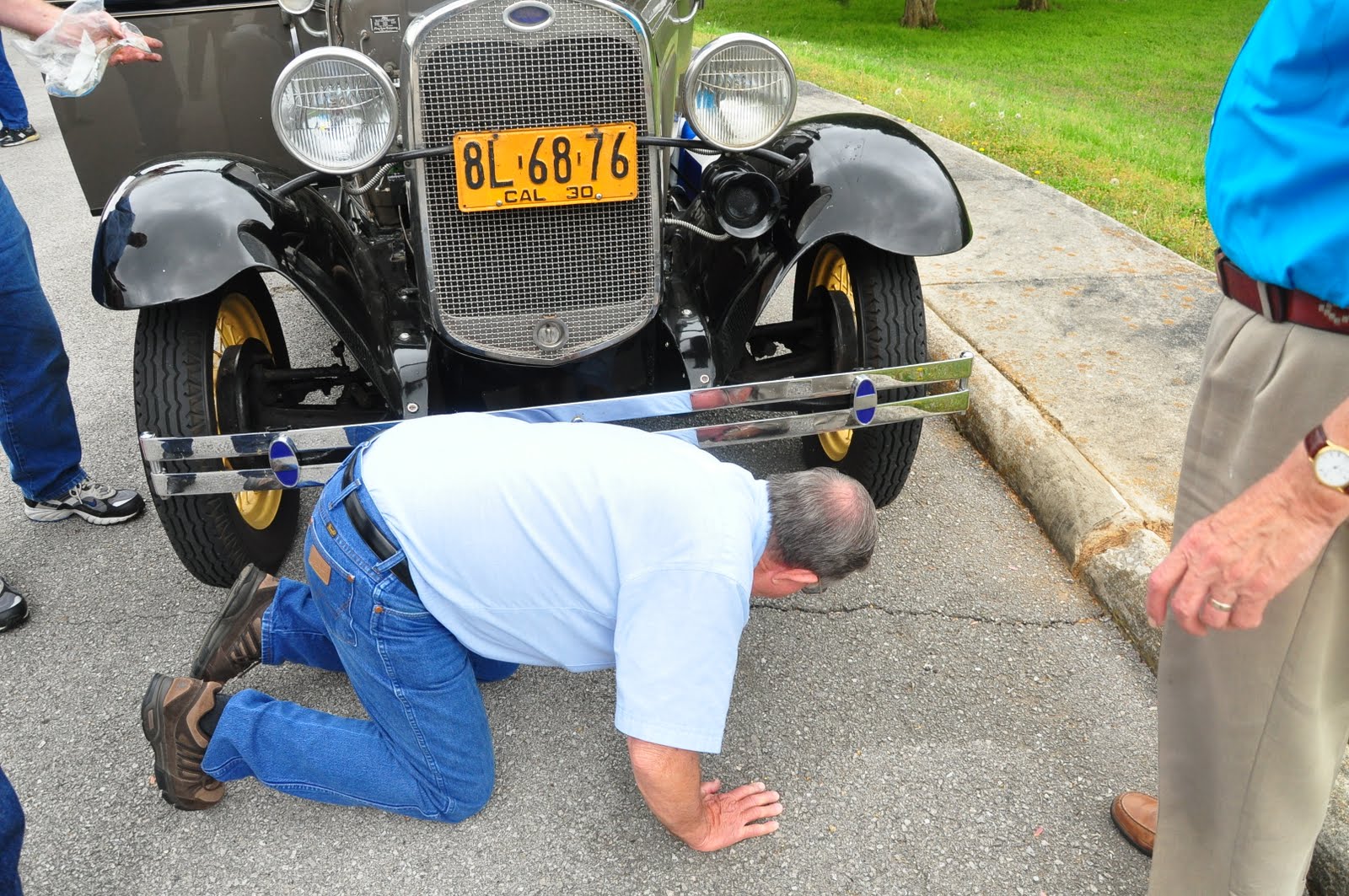
Model A'r,May Pass a Deal, Never a Meal


The Long & Winding Road
One of the most beautiful areas is Jackson Falls which requires a short but steep trek into a small valley. Everyone I heard agreed it was well worth the effort to get there.

As we arrived in Tupelo, it was starting to rain and there was a tornado alert. But by the end of dinner it was clear with great weather predicted for tomorrow.

Day 5, Nashville, TN

View From Hotel

Raffle Room

Donna Sells the Winning Tickets?
Sunday was warm and cloudy but gladly there was no rain. After relaxing in the morning, people broke into groups to check the sites of Nashville. Many traveled to downtown Franklin for some antique shopping while others visited Music City and strolled though the museums and famous Nashville music locations.


1-2-3-4-5-6-7-8-9-Just Keeps Going


Most of us visited the private car collection of Don Meadow’s fabulous Model A & T collection in White Bluff, TN. His collecting began in the 80’s and consists of dozens and dozen sand dozens of cars, primarily A’s &T’s. In his collection are three Model A mail trucks. The amazing thing is his main display “barn” is not even finished but he filled it with cars just for us and will move them out too complete the building. Everyone was amazed at his generosity and collection to say the least.

Later that evening we had our kick-off dinner where the raffle winners were announced. MAFFI raised around $6,000 for the Model A Museum. About half was raised when a guest (not affiliated with MAFFI) challenged people to make donations right there. We were running around collecting $100 bills! These generous donations totaled almost $3,000 in additional cash.

Cy Keeps everyone Laughing

The other highlight was Cy Tortoric from the Red Stick Chapter of Baton Rouge, LA.  Mr. Tortoric shared a little about himself. If you have never had an opportunity to meet and talk to someone raised in the bayou, you can’t begin to imagine the fun.

Saturday, April 9, 2011

Day 4, Franklin, TN


Going into the Grand Ol Opry

Today was a day of relaxation for our group and we took time to visit old friends and make some new ones. I had to get the Raffle in order which took a few hours but working with friends makes the time fly. This year two separate raffles are being held, one to benefit the Model A Museum and the other to offset any potential losses to MAFCA. The weather heated up to remind me how great the first 3 days have been. The report is for cooling back to the 70’s starting Monday-hope so!

Welcome to MAFCA

Little Jimmy Dickens

This evening 5 bus loads of Model A’rs went to the Grand Ol’ Opry where our introduction received the biggest applause of any other group attending. Little Jimmy Dickens kept all in-stitches and it seemed all were discussing on the ride back who they liked the most. I have wanted to visit the Opry since I was young. A few years ago we stayed at the Opryland Hotel but were not able to get to the Opry. I can now mark something off my bucket list. The entertainers were fantastic and it seemed everyone had a great time.

So far all those I have talked to are enjoying themselves.

Day 3, arriving in Nashville

Dorothy Burk, Doing Her Job

Dogwoods in Bloom
Day: 3 April 8, 2011
Beginning Mileage: 90,821
Ending Mileage: 91,026
Total Mileage:758

What a difference a day makes.

The group decided to leave a little earlier and with less than 200 miles to the Marriott in Franklin, TN, it would be a relaxing day. It started with an impromptu meeting with members from the Redstick chapter out of Baton Rouge. It’s always enjoyable to meet some Cajuns; nobody knows how to enjoy life better than they do. After sharing some laughs we hit the road and headed north.

One thing became obvious and that is how different the trees were. The further north we went the less the trees had budded and bloomed. I guess spring really does come later the further north you find yourself. Along the way we saw wild turkeys, lots of them. I was amazed how oblivious they were to us as we passed them.

Another Chicken For Yours Truly

Always to the Hardest to Reach Spot

Advisers

Chief Adviser
After leaving Texas, driving across Louisiana and through Mississippi, I made it to Tennessee before car problems struck. In fact, I coasted across the state line into Tennessee. Paul Lewis had called me on the cell wanting to find a place to pull over and adjust his points. No sooner did I hang the phone up and my engine started sputtering and cutting out. I’m sure Paul jinxed me. Hoping it was something simple like a dirty fuel filter, I removed it handed it to Jerry Burk who blew through it commenting that it seemed to be clogged up. We were on our way, for about 10 minutes. It was then I decided it wasn’t the filter after all; it’s an easy decision when the engine sputters and backfires every time you jump on the gas pedal. It seemed a small seed pod had some how gotten into my fuel line a few weeks ago when I had the engine out and worked its way to the float valve. A short time later we were on the road with no other problems.

Now I'm a TV Star
Interestingly, as we were stopped making repairs, a local TV news reporter stopped wanting an interview on the Trace about the potential government shut down. Since the Trace is part of the National Park system, there could have been some problems with the facilities being closed next week. So now I’m a TV star, or in Huntsville, AL.

An hour and half later we rolled up to the Marriott where we were immediately greeted by old friends. After checking in and freshening up, a group met in Jill and Garland Sullins’ room where a number of people (including all the Golden Triangle members present) helped stuff bags to be handed out for registration. After stuffing the bags we all stuffed our bellies with pizza - always good.

Thursday, April 7, 2011

Day 2, Natchez to Tupelo

Day: 2 April 7, 2011
Beginning Mileage: 90,520
Ending Mileage: 90,821
Total Mileage: 554

Ready to Leave


Crossing the Mississippi


Seven Model A's from the Dallas, Houston, Piney Woods and Golden Triangle A's chapters left Natchez and made their way to the Trace. Like yesterday, the weather was perfect and everyone looked forward to the almost 300 miles to Tupelo. The perfect weather added to the PERFECT MODEL A ROAD.

The wildflowers are starting to bloom with bright reds, yellows and violets around almost every bend. The dogwoods are also starting to bloom with their white blossoms and hopefully will be in full bloom as we turn around and head back next week.

So far nobody has had any car issues but, as Model A'rs have come to learn, something may jump out and bite at any time (hopefully not me). For some unknown reason I was selected as the day's leader and, as I seem to always do, started and ended the day exploring where no one wanted to go. But as always, it wasn't my fault -- Ms. Garmin gave the wrong directions. Regardless, we found where we were supposed to be and loved the drive.


Tomorrow we make the final drive to Nashville where the actual tour will begin on Saturday.

Wednesday, April 6, 2011

Day 1, Sour Lake, TX to Natchez, MS


Day: 1 April 6, 2011
Beginning Mileage: 90,267
Ending Mileage: 90520
Total Mileage: 253

We woke after a night of packing for two (for a week) and prying “other MAFCA stuff” into the coupe. I decided to remove the rumble seat cushions and add the luggage holder to the running board which allowed just enough room for everything. Besides that it's easy to reach out the window and get something cold to drink. Marshall Isaacson drove in Tuesday evening from Houston and spent the night. We met up with Jerry & Dorothy Burk out of the Golde Triangle A's for the day's drive.

Our journey took us from Sour Lake, Texas to Natchez, MS.  Avoiding major highways, we traveled north to Kirbyville (TX) and then cut east through DeRidder and Alexandria (LA) and then continued on to Natchez. One could not hope for nicer weather to spend the day in a Model A with high temps around 75 and clear blue skies.
We arrived in Natchez (we actually spent the night on the Louisiana side of the Mississippi River in Vidallia) to find fellow Model A’rs from Texas who also made the drive and will meet up with them tomorrow morning as we caravan on the Trace. Our plans are not to spend much time site seeing heading northeast but will spend time seeing the sites once we turn around and head back down the Trace on the actual tour.

At dinner it was decided that the "girls"will drive part of the day, this means Donna Lewis will have stay awake, something hard for her to do while riding in a Model A. We'll see!!!

Monday, April 4, 2011

Natchez Trace and the Model A Tour, How they came to be...


The Natchez Trace, How it came to be

First herds of bison, deer and other animals made their way seeking the necessities of life; food, shelter and salt. Then the nomads of the Americas found easier traveling on established animal trails than trying to labor their way through the dense forest and swamps. Following the Indian nomads, white men starting making use of the well established trail from the Cumberland River region to the great Mississippi River. Finally 20th century men realized the importance in preserving this historic passage way. Traveling almost 450 miles from Nashville, to Natchez, the Natchez Trace has been one of America’s longest surviving and most important roads. Since the early 19th century the “Trace” has been known by white man as the Natchez Trace, prior to that it was called the Chickasaw Trace” or the “Path to the Choctaw Nation”.
In the late 1700’s, considerable settling was being done in the Tennessee and Kentucky regions. Farmers and merchants were looking for ways to expand their markets and Natchez and New Orleans seemed logical destinations. The cost, both in labor and money to transport their goods down a rough undeveloped road was difficult not to mention dangerous. The preferred method was by boat. So farmers throughout the region built “flatboats” and floated the many rivers and waterways to the Mississippi river and down to Natchez or New Orleans. Once there they could sell their goods, dismantle their boats, sell the lumber, and then return on foot, along the Natchez Trace. This period became know as the “Boatman Era” when thousands made the trip from the 1780’s until around 1811.
As one might expect, with the wealth created by those making the trip down the river and up the Trace, a new enterprise rose up, the era of the outlaw. Gangs of thieves began looking for easy “pickens” but unlike the Boatman Era, these crooks and outlaws lived long after the Boatmen stopped traveling the Trace.
Around 1811, with the advent of the steamship these merchants were now able to travel home back up the Mississippi in relative safety and the “Boatmen era” ended.
The National Period followed the Boatman Era when it was decided that the Trace provide a good way of communicating with the newly established Mississippi Territory. Even though much of the territory was still under ownership of the Choctaws and Chickasaw nations, this was a period of American expansionism and the Trace was a major part of that process.
In 1801 the postmaster general wrote to the secretary of war informing him of the difficulties in maintaining mail service on the Trace “on account of the badness of the road”. Treaties in 1801 between the Choctaws and Chickasaws permitted improvements to the Trace. An improved road led to greater traffic which in turn led to more lodging along the Trace. This lodge known as “stands” and were found every few miles, offering a roof and hot meal.
As traffic increased so did the “banditti”. The army was stationed along the Trace to insure the safety of travelers from these thugs and outlaws. The banditti or highwaymen stole everything from money to slaves and had little regard for human life. It is little known that the highwaymen along the Natchez Trace were in fact the first organized crime in the United States as outlaws formed organized groups working together.
One of America’s best known figures, Merewether Lewis of the Lewis and Clark Expedition, life ended on the Trace. Lewis having served Thomas Jefferson as his personal secretary was appointed governor of the Louisiana Territory. In 1809 Lewis left for Washington traveling the Trace. On October 11, 1809 while spending the evening at Grinders Stand, shots were heard in the middle of the night. Mrs. Grinder went to investigate and found Lewis with multiple gun shots including one to the head. It was ruled a suicide? As all public figures having suffered an untimely death, the debate of suicide vs. murder has gone on since. In 1996 a Tennessee Grand Jury ordered Lewis’ body be exhumed and examined but since he is buried in a National Park, approval is required for the National Park Service, as of 2010 it still waiting approval. Be sure to visit Lewis’ grave and museum around Mile Marker 360.
In 1539 De Soto began exploring the south and for the next 200 years European explores continued exploring much of the south from Florida to Texas including the Mississippi Valley. Many historians believe De Soto’s men encountered the Trace just south of Tupelo. In fact De Soto died in 1542 and his body buried in the Mississippi River in the vicinity of Natchez. From the middle 1500’s to late 1700’s Europeans had many encounters with Native Americans living along the Trace many of these encounters were peaceful but many ended in war. In 1713 the French had established a trading post at Natchez. A short three years later, the Natchez people rose up and attacked with the French defeating them. Again in 1729 the Natchez rose this time killing close to 250 men and capturing an equal or greater number of women and children. The French struck back destroying the Natchez nations once and for all.
Over 10,000 years ago wondering people lived in the Tennessee and Mississippi valleys but because of the nomadic lifestyle little evidence of them is left. Starting around 10,000 years ago a major changes started, farming required less traveling and permitted settling in one area. Around 3000 years ago the Woodland Era began. With an increase reliance on agriculture and the introduction of pottery. This period existed for about 2200 years. During this period the spear was replaced with the bow and arrow. It was during this time that burial practices became more lavish and the dead were buried under burial mounds, some which are still found along the Trace.
The Mississippian Period followed around 700 A.D. Large temple mounds were built. Around these temples larger villages were established, many with defensive structures. Ceremonial art and intricate pottery was made and large scale agriculture became the norm.
Many of the temple mounds can be seen while driving the Trace, among them the Pharr Mounds consisting of 8 burial mounds from around 1-200 A.D. The Bear Creek Mound (ceremonial mound) build around 1200-1400 A.D. with its flat top and about 10’ tall is located in one of the oldest prehistoric sites, dating back 10,000 years. Emerald Mound, the largest covers 8 acres and was 35’ tall was built between 1250-1600 A.D. To see it exit the Trace at Mile Post 10.3 and drive about 1 mile (follow signs).  
The modern era for the Trace began in 1934 when local congressman Thomas Busby introduced a resolution calling for preservation of the Trace. President Roosevelt agreed, much because of his needed support from powerful Mississippi Senator Pat Harrison and because of the Great Depression and FDR’s Civilian Conservation Corps program was looking for public works projects.
Today the Natchez Trace it is a far cry from when Davy Crocket traveled it on his way to the Alamo; it is a modern highway stretching through 3 states. Dedicated to preserving the history, beauty and tranquility of the area, enjoy all 440 miles with no commercial traffic, stop signs or traffic lights - but be sure to enjoy it in a Model A.

How this tour came to be.
MAFCA’s Natchez Trace Tour unofficially started when Jill Sullins and I began discussing how to better meet MAFCA members’ expectations. Little did I realize when this talk began both Jill and I were heading down the same road. We both felt MAFCA desperately needed a regularly scheduled National Tour. During that conversation I told her of a trip Janet and I had taken a couple years before on the Natchez Trace. “What a great Model A road it was and what a great tour it would make…” 
A few weeks later Jim Spawn told MAFCA’s Board of Directors of a national tour he and Dick Przyitowski wanted to lead, celebrating the 150th Anniversary of the Pony Express. Seeing the Board of Directors support of this caused both of us to further develop and start working towards establishing national tours as a regular part of MAFCA.
Then it happened, Jill being who she is, called me to say that she had made contact with David Black, who had lead a dozen Model A tours on the Trace. Through the outstanding vision and leadership of Jill and David, the 2011 MAFCA National Tour down, the Natchez Trace is happening. It is our hope you appreciate this great bit of American history and beauty in one of “Henry’s Great Ladies”.


Tuesday, March 29, 2011

Preparing for the Tour


For four years I have anxiously waited for the Natchez Trace Tour to begin. I first encountered the Trace when my wife and I decided to travel it home from Nashville four years ago. The entire time we drove it, I could only think what a perfect MODEL A ROAD it is, no traffic signals or stop signs. No commercial vehicles and little traffic. The scenery wasn't bad either.

For me, the tour began early April when I decided a thorough inspection of the Model A and complete servicing was necessary. Five weeks later, after removing the engine twice, repairing a cracked block, a new pressure plate, 4 new tires and rebuilding the brake service shaft, I was able to drive the A for 200 miles at the Poor Boy Tour in Texas with no problems.

Now it's time for a good washing and packing and on Wednsday, April 6, we will hit the road for the 220 mile drive to Natchez where we will meet up with others to make the drive to Nashville for the start of the actual tour.